



News
2025
The big spread
300 m³ of peat moss on 6 hectares
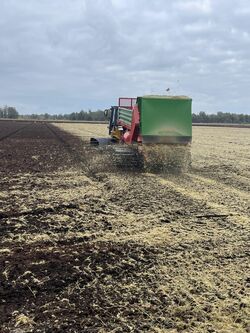
05/12/2025 A total of 300 m³ of peat moss was spread over 6 hectares in MOOSland. The project aims to help a small plant make it big – peat moss.
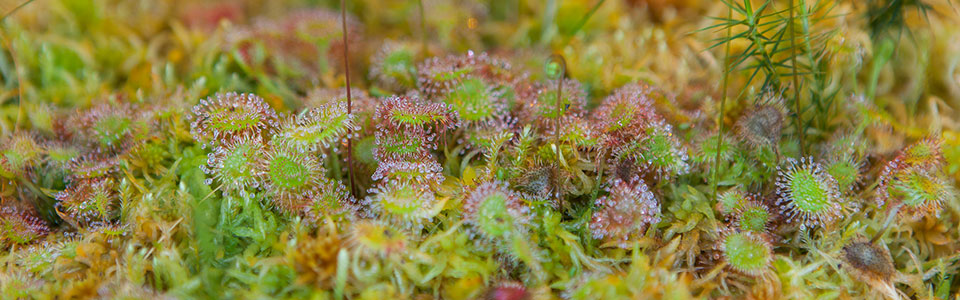
As a renewable raw material, it can replace peat in horticulture, e.g. in vegetable production. It can be cultivated in a climate-friendly manner on rewetted degraded raised bogs
and, with a total of only 10 t CO₂ eq/ha/year (including harvesting, cf. Daun et al. 2023), it performs three times better than raised bog grassland (32 tonnes) in terms of GHG emissions.
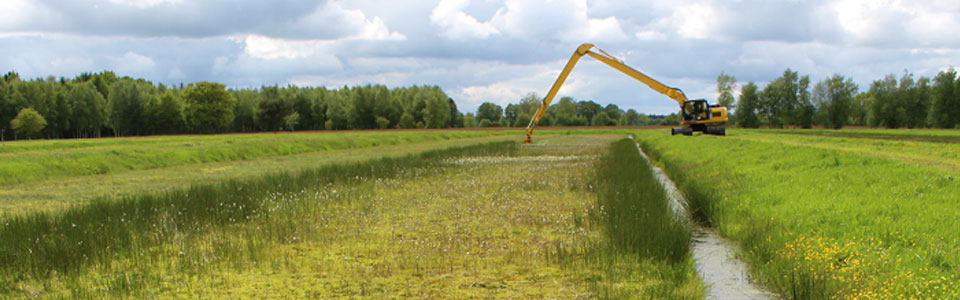
Research projects over the past 20 years have shown that sphagnum moss cultivation works. The cultivation method is now being optimised on the MOOSland trial areas in Hankhauser Moor and Barver Moor.
The land was prepared with particular care: only a minimal amount of topsoil was removed, access roads serve merely as boundaries, and the irrigation system has been minimised. Sowing was carried out using a caterpillar track to protect the sensitive peatland soil.
Scientists are now investigating how peat mosses grow in this new production system compared to the old one and what effects this has on greenhouse gas balance, biodiversity, hydrology, nutrients, economics, etc. The two sites differ in terms of climatic and hydrological conditions. The aim is to use this information to develop a handbook of measures for the successful implementation of peat moss paludiculture and its limitations. Both demonstration areas also serve as visual aids for numerous interested groups and, in particular, for the parallel stakeholder process in the two districts.
A video about the project can be viewed on Instagram.
🔗 More about the MOOSland model and demonstration project at moosland.net.
New: Eddy tower on peat moss
for accurate greenhouse gas emissions
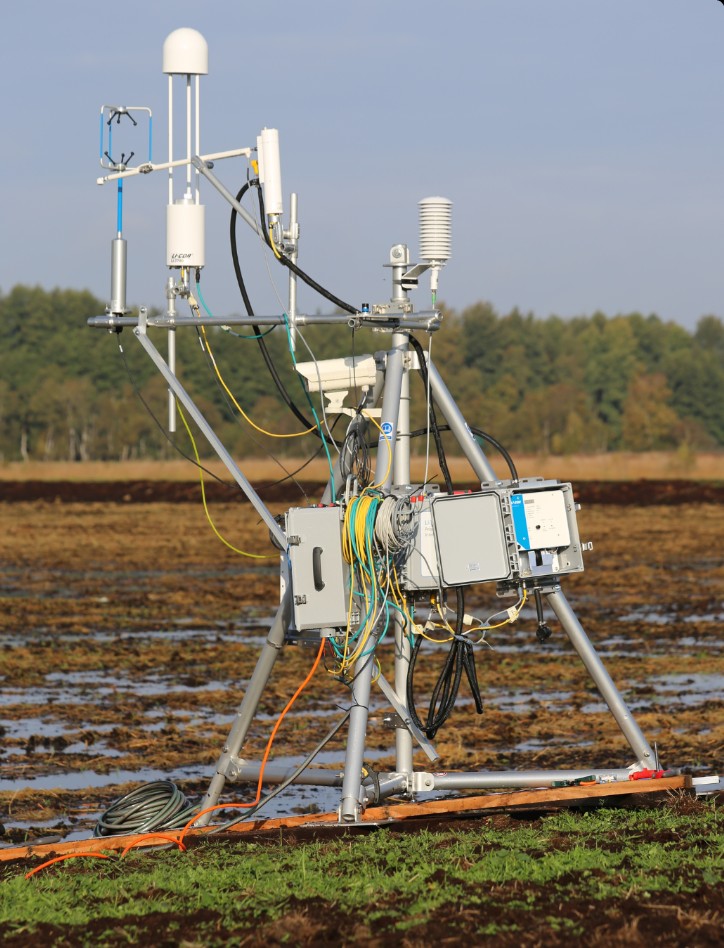
20/11/2025 A brand new eddy covariance tower has recently been installed on one of the pilot sites in the MOOSland project. It continuously records CO₂ and methane fluxes across the entire area, including causeways, ditches and peat mosses. Over the next eight years, scientists want to use it to measure how climate-friendly a peat moss paludiculture is.
The ‘Eddy’ took a day and three people to set it up, plus a lot of preparatory work, of course, such as testing the equipment in the laboratory, laying power cables to the site and building a rudimentary platform out of planks. The tripod was built up within four hours on site. Then, electrical boxes and data loggers were attached to the tower. These are responsible for communication between the instruments, including CO₂ and methane sensors, a camera, a pressure gauge and a router for data transmission to the outside world. Each instrument has its own IP address for remote access. This not only enables the instruments to be accessed, but also controlled – a special feature of this Eddy tower that goes beyond the standard. The following day, only a little fine-tuning was needed to optimise the angles, distances and alignment of the sensors. Now the ‘Eddy’ is up and running, and the scientists expect to receive the first evaluations in about a month.
Why it matters: The collected data provides a reliable basis for policymakers, businesses and researchers to assess and optimise the climate impact of peat moss paludiculture.
More insights can be seen in this video.